
Denon DRA-685: One Speaker Silent
- Symptom
- A Denon DRA-685 stereo receiver came in with a speaker that wouldn't play. Different cables and different speakers had already been tried, and the problem stayed with the receiver.
- Diagnosis
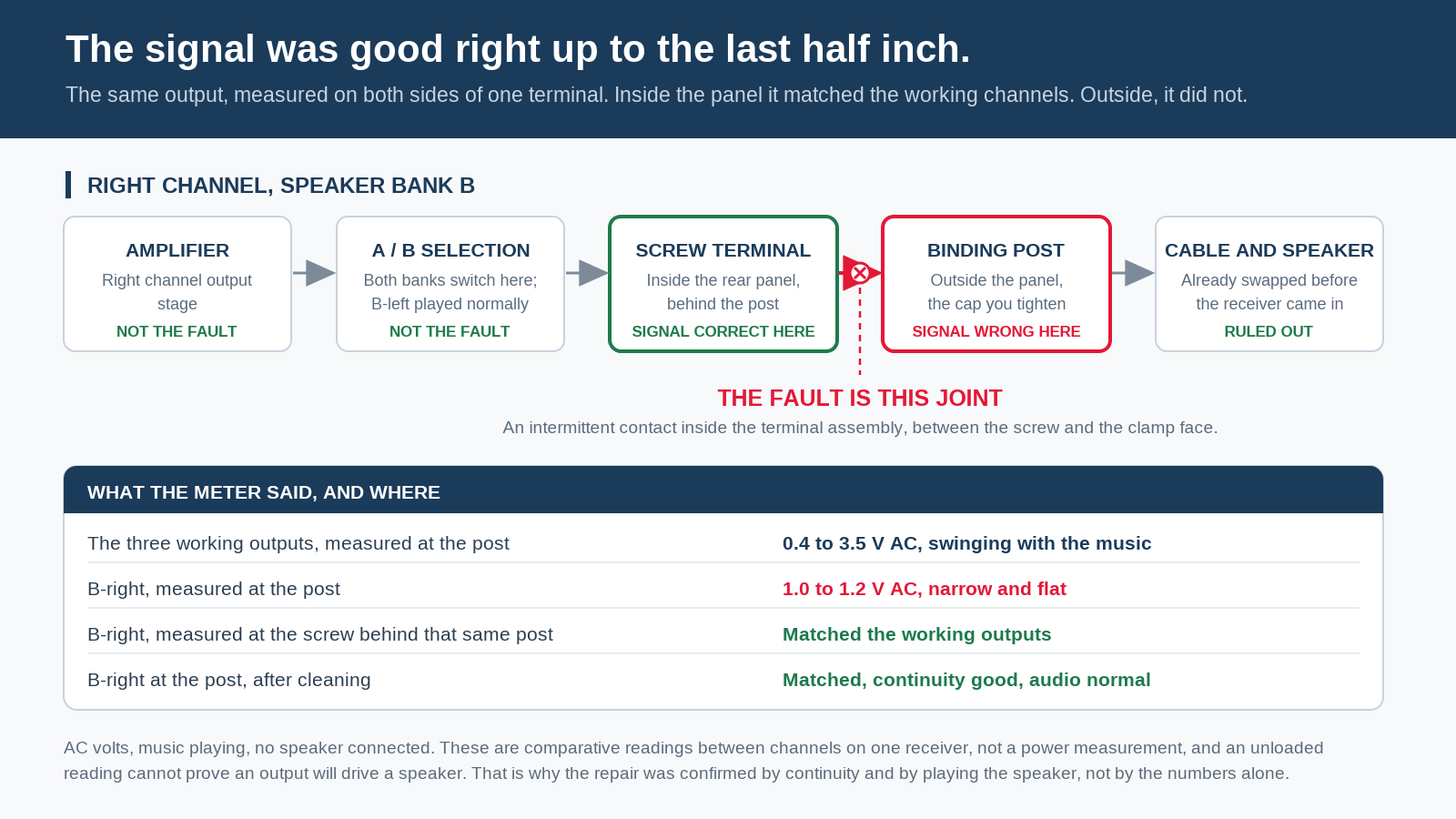
- Each output was tested on its own: A-left, A-right and B-left all played, while B-right was silent and later proved intermittent rather than dead. Measured at the screw terminal inside the rear panel, B-right matched the working outputs. Measured at the binding post on the outside, it didn't. The fault was an intermittent contact in the terminal assembly itself, downstream of everything that could have been expensive.
- Fix
- Cleaned the contact surfaces of the affected binding posts with contact cleaner. Continuity from the post through to the internal screw then checked good, the readings matched the working outputs, and the speaker played. We cleaned the remaining speaker terminals the same way, power-cycled the receiver, and retested every output. No parts replaced.
The Receiver
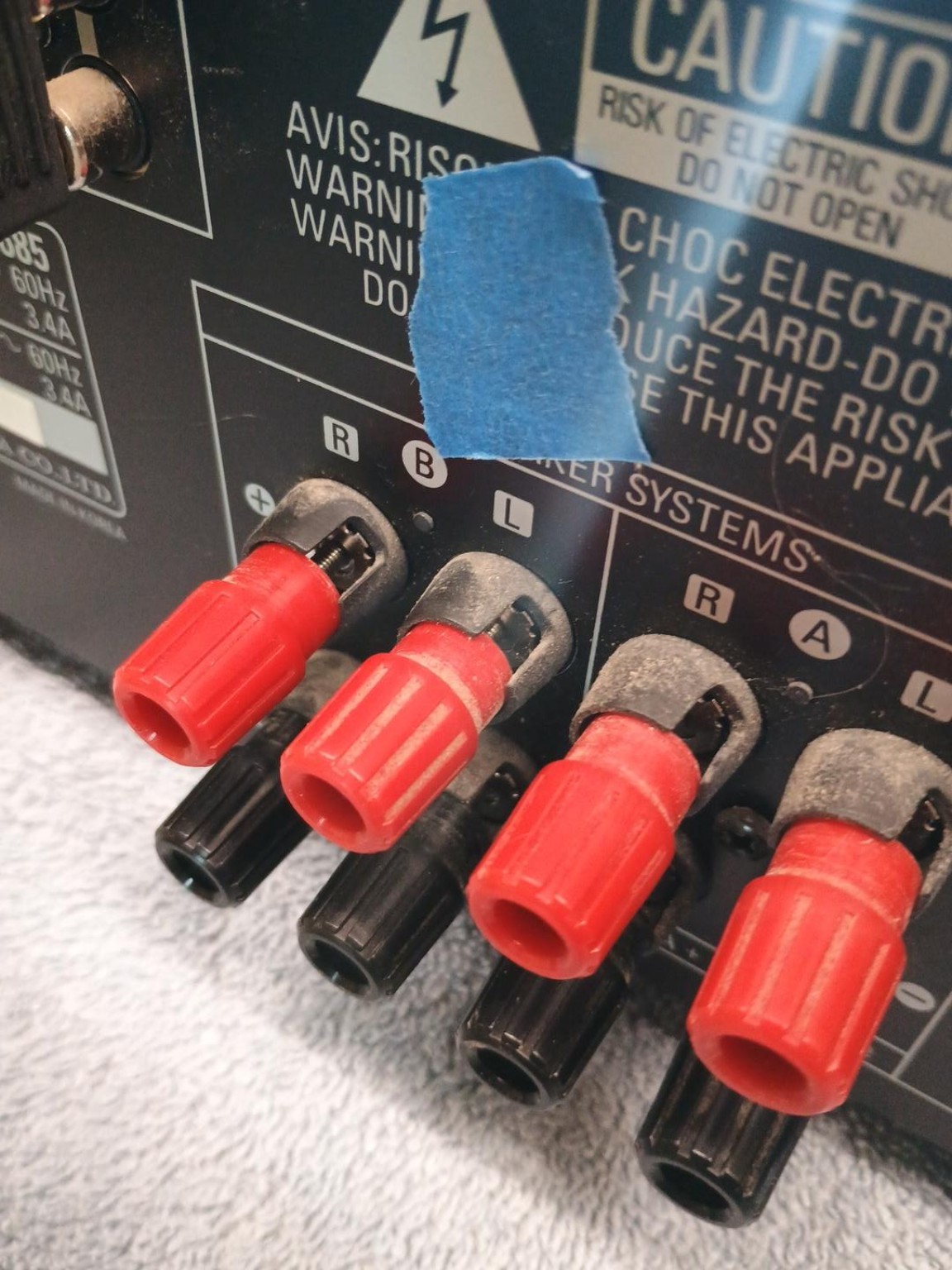
A Denon DRA-685, a two-channel stereo receiver with an AM/FM tuner and two sets of speaker outputs, A and B, selectable from the front panel. Eight binding posts across the back: a red and a black for each of A-left, A-right, B-left and B-right.
That layout matters to this repair for one reason. There is no single “left speaker” on a receiver like this. There are two of them, on two banks, and which one is doing the work depends on which bank is selected and where the cables happen to be landed. A symptom described from the listening position is a description of what the room sounds like, not a map of which of the four outputs has the problem. Finding that out is a bench job.
The Symptom
One speaker had stopped playing. Before the receiver came to us, a different cable and a different speaker had both been tried on it, and the problem stayed where it was.
That is more useful than it sounds, and it saved real time here. Swapping the cable and swapping the speaker are the two tests that separate “the receiver has a problem” from “something downstream of the receiver has a problem,” and both had already been run. The fault was in the box, and we could start there instead of spending the first half hour proving it.
Which Output, Exactly
The first job was to stop talking about “left” and start talking about one of four specific outputs. Each one was driven and checked on its own: A-left played, A-right played, B-left played. B-right did not.
It also did not stay consistently dead. Over the course of testing, audio could sometimes be got out of B-right and sometimes not. An intermittent output is a different animal from a dead one, and the difference is diagnostically valuable: a component that has failed outright tends to stay failed, while something that works and then doesn't, depending on the moment, points at a connection rather than a part.
Measuring Both Sides of One Terminal
With the receiver playing and no speaker connected, we compared the four outputs with a multimeter on AC volts, probing red to black at each pair of posts. The three working outputs read somewhere between roughly 0.4 and 3.5 volts, the number wandering as the music changed. B-right sat in a narrow band around 1.0 to 1.2 volts and mostly stayed there.
On its own that is a hint, not a finding. A meter chasing a music signal is not making a measurement in any strict sense, and with nothing connected to the output there is no load, so the reading says nothing about whether the amplifier could actually drive a speaker. What it does give you is a comparison: four outputs, one receiver, one moment, and one of them behaving differently from the other three.
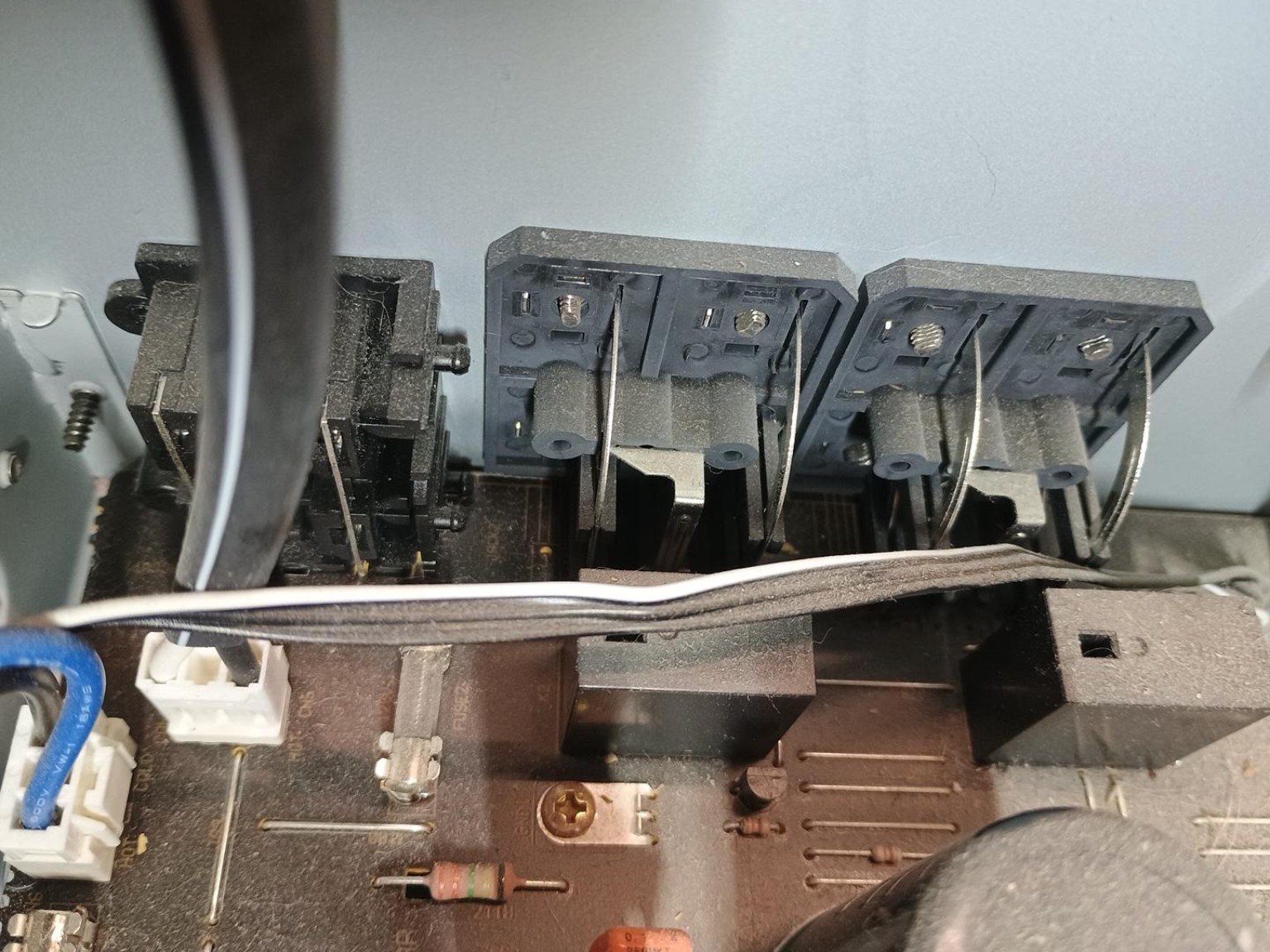
The check that settled it was moving the probes. Each binding post has an exposed screw connection on the inside of the rear panel, which is the same signal a few millimetres earlier in its journey. Measured there, B-right matched the working outputs. Measured at the post on the outside, it didn't. Everything upstream of that screw — the amplifier stage, the A/B selection, every connection in between — was delivering the signal correctly. Whatever had actually failed lived in the short run of metal between the screw and the outside of the post.
The Fix
Contact cleaner on the affected posts, worked into the contact surfaces. That is the entire repair.
Then three checks, in order, because one of them on its own wouldn't be worth much. Continuity from the outside of the post through to the screw terminal behind it: good. The AC comparison repeated across all four outputs: B-right now matched the other three instead of sitting apart from them. And the one that actually counts, a speaker connected and playing: normal.
We then cleaned the remaining speaker terminals the same way — the other three pairs were working, but they are the same age and the same hardware as the pair that wasn't — power-cycled the receiver, and retested every output. All four played as expected. No parts were replaced on this repair.
The Takeaway
A receiver with one silent channel invites you to think about the expensive things: output devices, a protection relay, a damaged amplifier board. On this one, the signal was arriving correctly within a few millimetres of the speaker cable and failing to complete the last step of the trip, at a connector designed to be opened and closed by hand and old enough to have been opened and closed a few times.
Connections are not a glamorous answer, but they are a common one, and they are cheap to rule in or out if you look early. The receiver went back with every original component still in it.
What This Job Shows About How We Work
Turn the reported symptom into a specific output.
A description from the listening position tells you what the room sounds like. It can't tell you which of four outputs is at fault, because that depends on bank selection and cable routing. Driving each one on its own takes a few minutes and replaces a guess with a fact, and it is the step that decides where the rest of the time goes.
Measure the same signal in two places.
A single reading tells you a value. Two readings on opposite sides of one component tell you which side the problem is on, and that is a different and far more useful kind of information. It's the same logic whether the thing in the middle is a terminal, a connector, a cable run or a fuse.
Say what a measurement can and can't prove.
The voltage comparison on this job pointed us in the right direction and could not, by itself, confirm the repair. So it didn't have to: continuity and a speaker actually playing did that. Knowing which of your checks is evidence and which is just a hint is most of what keeps a diagnosis honest.
Credit the work that was already done.
Swapping the cable and the speaker before the receiver came in eliminated an entire branch of the diagnosis. We don't redo tests somebody has already run properly, and we'd rather say so than quietly bill for repeating them.
Technical Details
| Equipment | Denon DRA-685 two-channel stereo receiver, two switchable speaker outputs (A and B) |
| Reported symptom | A speaker not playing; cable and speaker already substituted, with no change |
| Localized to | B-right. A-left, A-right and B-left all played normally when driven individually |
| Behavior | Initially silent; audio later obtainable but inconsistent, which is what pointed at a connection rather than a failed part |
| Comparison method | Multimeter on AC volts, red probe to red post and black to black, music playing, no speaker connected |
| Working outputs | Roughly 0.4–3.5 V AC, fluctuating with the program material |
| B-right at the post | Roughly 1.0–1.2 V AC, a narrower range than the working outputs |
| B-right at the internal screw | Comparable to the working outputs — the finding that localized the fault |
| Limit on those figures | Comparative readings between channels on one receiver, taken on a changing audio signal with no load. Not an output-power measurement, and not sufficient on their own to confirm a repair |
| Fault | Intermittent contact within the B-right terminal assembly, between the internal screw connection and the external post |
| Work performed | Contact surfaces of the affected posts cleaned with contact cleaner; remaining speaker terminals cleaned as well |
| Verification | Continuity post-to-screw good; AC readings matched the working outputs; speaker played normally; receiver power-cycled and all four outputs retested |
| Parts | None |
| Guarantee | 30 days on the repair we did |
A Note on This Write-Up
This describes one receiver, not a universal answer. A silent channel on another unit can just as easily be a failed output stage, a protection relay or a source selector, and none of those were individually tested here — they didn't need to be, because the signal measured correct at the terminal's inside face, which puts all of them upstream of the problem. Read that as “not the fault on this receiver,” not as “ruled out by measurement.”
Two other things are deliberately not claimed. We didn't establish which of the two posts carried the bad contact, so the page says “the affected posts.” And we didn't establish what was on the contact faces — the behavior is consistent with a poor contact and that is as far as the evidence goes, so you won't find the words oxidation or corrosion above.
If you're looking at your own receiver: the outside of the box is fair game, and working the binding posts and reseating the cable is a reasonable thing to try with the unit unplugged. Inside is not. A receiver runs on line voltage, its power supply holds a charge after the cord comes out, and the measurement that solved this job was taken in a running chassis on a bench, by someone doing it deliberately and with the hazards identified first. It's described here because it's what the repair turned on, not as a step to copy.
One Channel Gone Quiet?
Receivers, amps, powered speakers, TVs and the boxes feeding them: the process on this page is the process on all of them. Find out what's actually failing before anything gets replaced, and say plainly which findings are solid and which aren't. Sometimes the answer is that nothing needs replacing. See electronics repair for what we cover locally, mail-in audio and amp restoration if you're shipping something in, or what diagnosis and repair cost before you book. Not sure it's something we handle? Describe it first — make, model and symptoms, no charge to ask.
Not sure it's worth fixing? Tell us the make, model, and what it's doing, or call (509) 708-2953 — no charge to ask, and nothing to book. Send us the details →
That conversation can usually tell you whether a repair is worth pursuing and which diagnostic fits. A firm repair price takes having the device in hand.
Nothing is charged when you book a drop-off. The $50 diagnostic covers the first 30 minutes, is the same wherever you're coming from, and is billed on your final invoice once the work is finished.