
LG Washer OE Drain Error
- Symptom
- An LG WM3470HWA front-load washer stopped mid-cycle with water still in the tub and an OE error on the display.
- Diagnosis
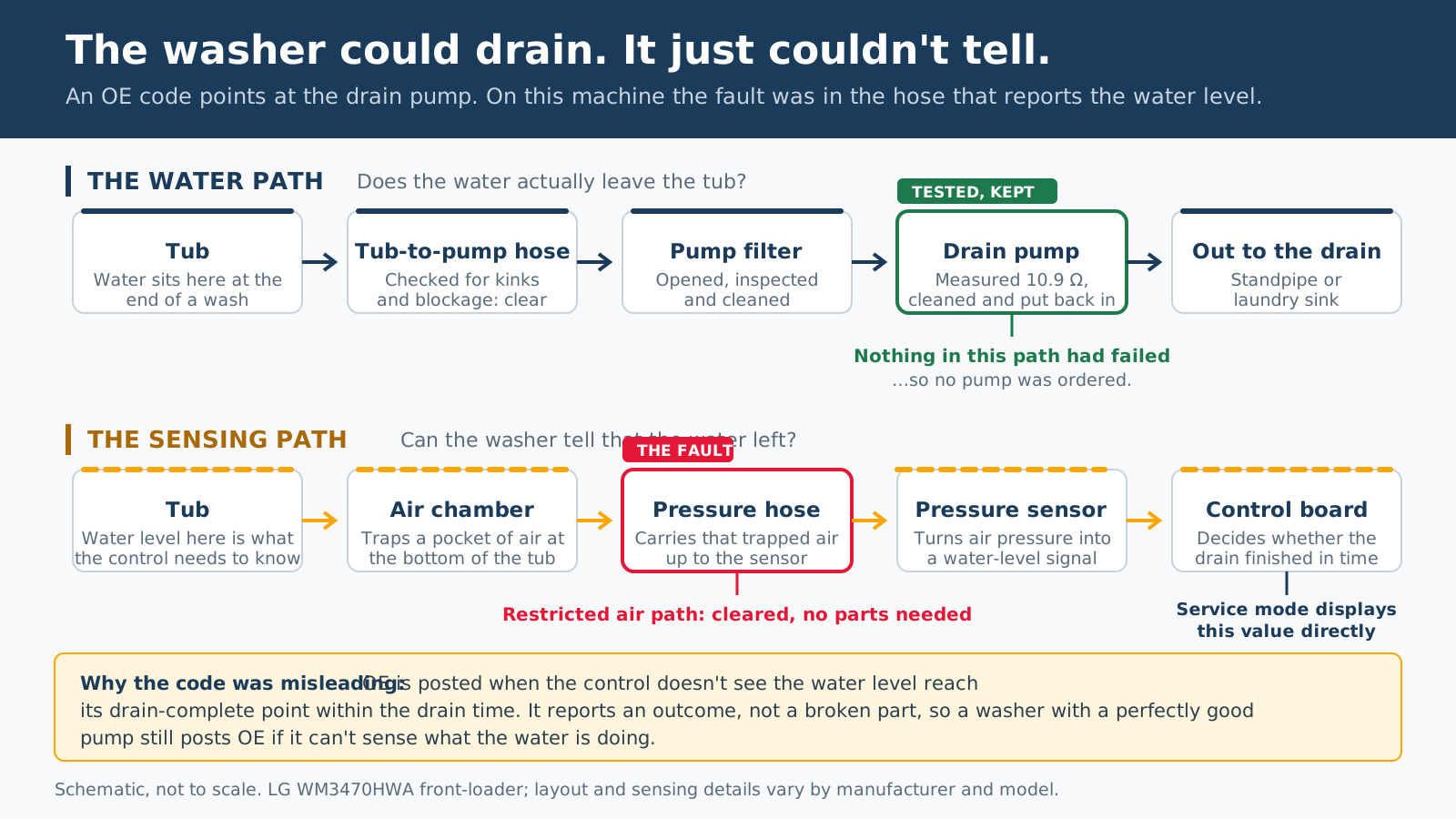
- The whole drain path checked out: hose, filter, and the pump itself, whose winding measured a healthy 10.9 Ω. The fault was in the air path the washer uses to sense its own water level: restricted, so the level value in service mode sat around 250 while the pump emptied the drum, never climbed to the 260 that means empty, and the control timed out the drain step.
- Fix
- Cleared the restriction in the pressure-sensing air path and refitted the cleaned original pump. The washer drained and advanced normally through a full cycle. No parts replaced.
An LG WM3470HWA front-load washer came in stopping mid-cycle with water still in the tub and OE on the display. Look that code up and you'll be sent to the drain pump, and a lot of the time that's where it ends. On this machine the pump was fine. It measured fine, it got cleaned, and it went back into the washer it came out of, because the thing that had actually failed wasn't in the drain system at all.
What This Page Is For
An error code names a symptom, not a broken part. OE on an LG washer means the machine didn't see the tub drain the way it expected, and there is more than one way to produce that result. Only one of them involves a bad pump.
This write-up is here because of how it ended: nothing on this washer was replaced. That's not a small detail, it's the whole argument. The gap between the obvious suspect and the actual culprit is exactly the gap that diagnosis is supposed to close, and closing it is the difference between a cleaning and a parts bill.
The Long Version
Why the Pump Stayed in the Machine
What follows is the diagnosis in the order it actually happened, including the point where ordering a pump would have been the easy call. Skip to the result if you'd rather not read the meter readings.
What an OE Code Actually Reports
On an LG front-loader, OE is a drain error. It's tempting to read that as "the drain pump is dead," but that isn't what the machine is telling you, and on this washer the difference was worth the entire cost of a pump.
There's no sensor on the pump. The control board can't tell whether the pump is spinning, whether the impeller is turning water, or whether anything is coming out of the drain hose. What it can do is run the drain step and watch the water level. If the level hasn't reached the point the machine considers empty by the time the drain step is over, it stops and posts the code.
So OE is best read as: "I ran the drain, and the water level didn't get where I expected it to get." A pump that can't move water produces that. So does a perfectly good pump on a machine that can't see its own water level. Same code, and only one of the two costs a part.
Starting With the Checks That Cost Nothing
Before anything came apart, the drain path got the basic inspection it always should:
- The external drain hose, checked for kinks, crushing, and a blockage at the standpipe
- The pump filter, opened, inspected, and cleaned (the usual haul of lint, hair, coins and buttons collects here)
- The hose running from the tub sump to the pump, checked for a restriction upstream of the pump itself
These go first for a practical reason, not just a frugal one: a clogged filter and a failed pump produce an identical code, and one of them is free to fix. Plenty of OE calls end right here.
This one didn't. Every part of the drain path was clear, and the washer still wasn't completing a cycle. The pump itself was the next thing to look at.
Testing the Pump: What the Meter Could and Couldn't Say
With the machine unplugged, I pulled the drain pump, inspected it, and measured across its motor winding:
| Measurement | Reading | What it establishes |
|---|---|---|
| Drain pump motor winding | About 10.9 Ω | The winding is continuous and in a plausible range; it has not gone open |
The impeller and housing were clear and undamaged, so the pump got cleaned while it was out and went back into the machine.
Now, an honest word about that reading, because it would be easy to present it as more conclusive than it is. A resistance measurement looks at the winding sitting still, cold, unpowered, and carrying no load. Several things that stop a pump from moving water leave that measurement looking perfectly normal:
- Mechanical failure in the pump end. A worn, cracked, or obstructed impeller has no electrical signature at all. The motor can run exactly as designed and still move nothing.
- Bearing drag. A rotor that spins freely by hand can still fail to reach speed against a tub full of water.
- A shorted turn. Shorting a handful of turns out of several hundred barely moves the reading on a meter, but it costs the motor real torque and makes it run hot.
- Anything that only appears under load or once warm. A bench reading captures none of it.
So the meter didn't clear this pump on its own. What it did was rule out the one failure mode it's genuinely good at, an open winding, and leave the pump as an unconfirmed suspect rather than a condemned part. That distinction is what the next decision turned on.
The Decision Not to Order a Pump
This is the moment the job could have gone either way, so it's worth being explicit about it.
The drain path was clear, the pump looked and measured healthy, and the washer still wouldn't finish a cycle. At that point a pump is the obvious next move. It's the part the code is associated with, it's not expensive, and if it fixes the machine nobody asks any more questions. It's also a guess, and a guess that a 10.9 Ω reading and a clean impeller both argue against.
The alternative is to go back to what the code actually reports. Not "the pump failed," but "the water level didn't get where I expected." That sentence has two halves, and only one of them had been investigated. The water was one half. The machine's ability to see the water was the other.
Nothing so far had tested that second half at all.
How a Washer Knows How Much Water Is In It
No float, and nothing electrical down in the water. The machine measures air.
At the bottom of the tub there's an air chamber, a small trap that holds a pocket of air. A thin hose runs from that pocket up to a pressure sensor mounted high and dry near the control board. As water rises in the tub it compresses the trapped air, and the pressure in that hose rises with it. The sensor converts that pressure into an electrical signal, and the control board reads the signal as a water level.
It's an elegant design: the sensor never touches water, so it never corrodes and never gets fouled with detergent. The cost of that design is that the machine's only knowledge of its own water level travels through a narrow tube full of air. Interfere with the tube and the washer goes blind, while every part that looks important is still working perfectly.
Which raises the obvious question. If the machine's entire understanding of its own water level is a column of air in a tube, how do you find out what it's actually reading? You ask it.
Asking the Washer What It Sees
Like most modern appliances, this LG has a service test mode, a diagnostic mode entered at the control panel, separate from the normal wash programs. It exists so a machine can be exercised and interrogated one function at a time, rather than judged from the outside by whether a cycle happens to finish.
The function that mattered on this job displays the water level the control is currently reading. That takes the invisible middle of this whole problem, air pressure in a hidden tube converted to a signal on a wire, and puts it on the front of the machine as a number.
Getting Into It on This Machine
On this WM3470HWA, with the drum empty and the machine powered off:
- Press and hold Spin Speed and Soil Level together.
- With both still held, press Power. The panel comes up in test mode rather than in a normal wash program.
- Press Start/Pause repeatedly to step through the component tests one at a time. Each press advances to the next stage.
- On this control platform the drain sequence lands around the eleventh press. That's the stage where the pump runs and the display shows the water-level value the control is reading.
The value on screen is a frequency the pressure sensor returns, not gallons or inches, and it runs backwards from what you'd expect: the sensor's output frequency falls as pressure rises, so a low number means a full tub. With water in the drum it sits somewhere in the 230 to 250 range on this machine, and as the pump clears the water it should climb steadily to 260, the value this control reads as a completely empty drum.
So rather than inferring what the washer believed about its own tub, I could read it directly. Stepped to the drain test and watching the display while the pump ran, the value sat at around 250 and stayed there. The pump ran. Water came out of the drain hose. The number on the panel never climbed.
That's the whole fault in one observation. The machine was still reporting a tub with water in it, minutes after the water was gone. It never reached 260, so as far as the control was concerned the drain had failed, and when the drain step ran out of time it did the only thing it can do: stop and post OE over an empty drum.
That's the observation the rest of the job turned on. It split the two halves of the OE definition cleanly apart: the water, and the report of the water. One of them was still working, and it wasn't the one the error code points at.
The Same Readout Verified the Fix
This is worth pulling out on its own, because it's the part that turns a plausible repair into a confirmed one. The level display found the fault, and then it proved the fix: once the air path was cleared, I went back into the same drain test, ran it again, and watched the value climb up to 260 as the water left, the way it should have all along.
Without that, the strongest available claim is "it seems to work now," which is a statement about one cycle on one afternoon. Watching the level signal follow the water is a statement about the specific thing that was broken. Those are very different standards of proof, and only one of them is worth putting a guarantee behind.
If You're Looking This Up For Your Own Machine
The sequence above is what worked on this WM3470HWA. How you enter service mode differs between LG models and sometimes between production runs of the same model, the press count that lands on the drain test moves around with the control platform, and the level values aren't on a common scale from machine to machine either, so a number that means "empty" on this washer won't necessarily mean that on yours. All three are worth confirming against the service documentation for your specific model and serial rather than carrying this procedure across.
Finding the Restriction in the Air Path
I disconnected the pressure hose and tested whether air moved through it freely. It did pass air, but with noticeably more resistance than it should have. It would barely bubble unless I blew through it hard.
Restricted rather than blocked is exactly the right fault for this symptom. A restricted air path still equalizes, just slowly, and "slowly" against a drain step that lasts a few minutes is indistinguishable from not at all, which is why the readout looked frozen. So the tub empties, the pressure behind the restriction lags far behind reality, the reported level never climbs to 260, and the drain step runs out of time waiting for a number that is going to arrive long after the machine has given up on it. The washer posts OE over a tub it has already emptied.
The Test That Settled It
With the pressure hose disconnected from the sensor, the washer advanced through its cycle normally.
That result is worth unpacking, because it's easy to over-read. An open port leaves the sensor breathing plain atmospheric pressure, which is exactly what it would see on a genuinely empty tub, and it reports the value to match: 260. The machine read "empty," was satisfied, and carried on. What that proves is that the sensor and the control board are both doing their jobs, and that the thing holding the cycle hostage was the level signal rather than anything in the drain system.
On its own it doesn't convict the hose. It's the combination that does: a sensor and board demonstrably working, plus a directly measured restriction in the air path between them and the tub.
I cleared the restriction by blowing the air path through with it disconnected at both ends, checked the air chamber at the tub, and reconnected everything. One detail matters here: clear the hose with it off the sensor. Pressurizing a level sensor by blowing into a hose that's still attached to it risks pushing debris and moisture straight into the part you're trying to prove is healthy.
Why These Restrict in the First Place
The tube sits above a tub full of warm, soapy water for years. Detergent residue, softener, lint and sludge gradually work their way into the air chamber and the first stretch of hose, and condensation collects in any low spot in the run. Front-loaders are more prone to it than top-loaders because they use so little water that the wash is more concentrated. If you want to make it less likely on your own machine, the two things that help most are dosing detergent for the actual load rather than by habit, and running an occasional hot cycle to keep residue from setting up, the same maintenance that keeps the door gasket from turning black.
The Diagnosis In Order
| Step | Result | What it ruled in or out |
|---|---|---|
| Drain hose and standpipe | Clear | No external blockage |
| Pump filter | Inspected and cleaned, no change | The most common free fix eliminated |
| Tub-to-pump hose | Clear | Restriction upstream of the pump eliminated |
| Pump inspection | Impeller and housing clear, cleaned and refitted | No visible mechanical failure |
| Pump winding resistance | About 10.9 Ω | Open winding eliminated; not enough on its own to clear the pump |
| Service mode drain test, water-level value watched | Stuck around 250 while the pump ran and water left the drum; never climbed to 260 | Moves the search from draining to level sensing |
| Pressure hose airflow | Passes air, but restricted | Restriction found in the sensing path |
| Cycle with the hose disconnected | Advances normally | Sensor and control board both working |
| Restriction cleared, service mode drain test re-run | Value now climbs from the 230–250 range to 260 as the water leaves | Repair verified against the exact signal that had failed |
| Full normal cycle, everything refitted | Drains and advances, original pump in place | Single fault confirmed; pump retroactively cleared |
Read down that list and the shape of the job is clear enough. One fault, in the system nobody thinks about, wearing the error code of the system everybody does.
The Result
With the pressure-sensing path cleared and the original cleaned pump back in place, verification ran in two stages. First in service mode, watching the water-level value through the drain test; this time it climbed to 260 as the drum emptied instead of sitting at 250. Then a full normal cycle from the front panel: it drained, it advanced, and the OE error did not come back.
That outcome is also what finally settled the question about the pump. A resistance reading left it an unconfirmed suspect; watching the machine complete a full cycle with that same pump still in it is what actually proved it was healthy. The evidence that closes a diagnosis often arrives at the end, and it's usually the machine doing the talking.
No parts were replaced on this washer. Not a pump, and not a control board, which is where an OE error that survives a new pump tends to send people next. The repair was a diagnosis and a cleaning.
What This Job Shows About How We Work
An error code names a symptom, not a part.
OE told us the machine didn't see the tub drain. Two entirely different systems can produce that, and the code has no way of distinguishing them. Working out which one you have is the job.
Check the free things before the expensive things.
A clogged filter and a dead pump look identical from the display. One of them is a ten-minute fix with no parts. That check goes first every time, even when it's unlikely.
Know what a measurement can't see.
10.9 Ω across a pump winding rules out one specific failure and nothing else. It wasn't enough to condemn the pump, and it wasn't enough to clear it either. Being clear about which of those a reading supports is how you avoid acting on it too early.
Ask the device what it thinks is happening.
This washer has a service mode that displays the water level it's reading, which turned the invisible half of the problem into a number on the panel. Computers have their own versions: POST codes, SMART data, event logs. Reading what a device reports about itself beats inferring it from the outside, and it's almost always faster.
The obvious suspect is not automatically the culprit.
The pump is where an OE diagnosis usually ends. Ordering one here would have been quick, defensible, and wrong: a part, a bill, and the same code still on the display afterward.
Test the whole system, and let the outcome close the loop.
The end of this job did two things at once: it verified the repair against the exact signal that had failed, and it proved the part we chose not to replace was genuinely fine. "It seems to work now" is not the same standard.
Evidence decides what gets replaced. Here, nothing did.
The most useful thing a diagnosis can do is tell you what you don't have to buy. This washer went home working, with every part it arrived with.
Technical Details
| Machine | LG WM3470HWA front-load washer |
| Error | OE, a drain error |
| Pump winding measured | About 10.9 Ω |
| Fault found | Restriction in the pressure-sensing air path |
| Service mode entry | Drum empty, power off: hold Spin Speed + Soil Level, press Power |
| Diagnostics used | Service test mode, stepped with Start/Pause to the drain test (about the 11th press); water-level value observed before and after the repair |
| Level values on this control | Roughly 230–250 with water in the drum, 260 empty; stuck around 250 before the repair |
| Work performed | Drain path inspected and cleaned, pump tested, cleaned and refitted, air path cleared |
| Parts replaced | None |
| Outcome | Level sensing restored, OE cleared, full cycle completed normally |
A Note on This Write-Up
This describes one specific repair on one specific machine, not a universal procedure. Washer designs vary considerably between manufacturers and between models from the same manufacturer, and an OE error on a different LG can easily have a different cause than the one found here, including, quite often, a genuinely failed pump. If you're working on your own machine: unplug it and shut off the water first, and expect the drain filter to hold more water than you think it does.
Got Something Throwing a Code Nobody Can Explain?
Computers, consoles, TVs, control boards, generators, amps: the process on this page is the process on all of them. Work the evidence, find out what actually failed, and fix that. Sometimes the answer is that nothing needs replacing. We'll tell you honestly what we find either way, including when a repair isn't worth doing. See what diagnosis and repair cost before you book, or describe the problem first if you're not sure it's something we handle.
Prefer to describe the problem first? Send us the details →
A $50 deposit is charged when you book; it comes off what you owe for the visit and is refundable if you cancel or reschedule at least 24 hours ahead.